
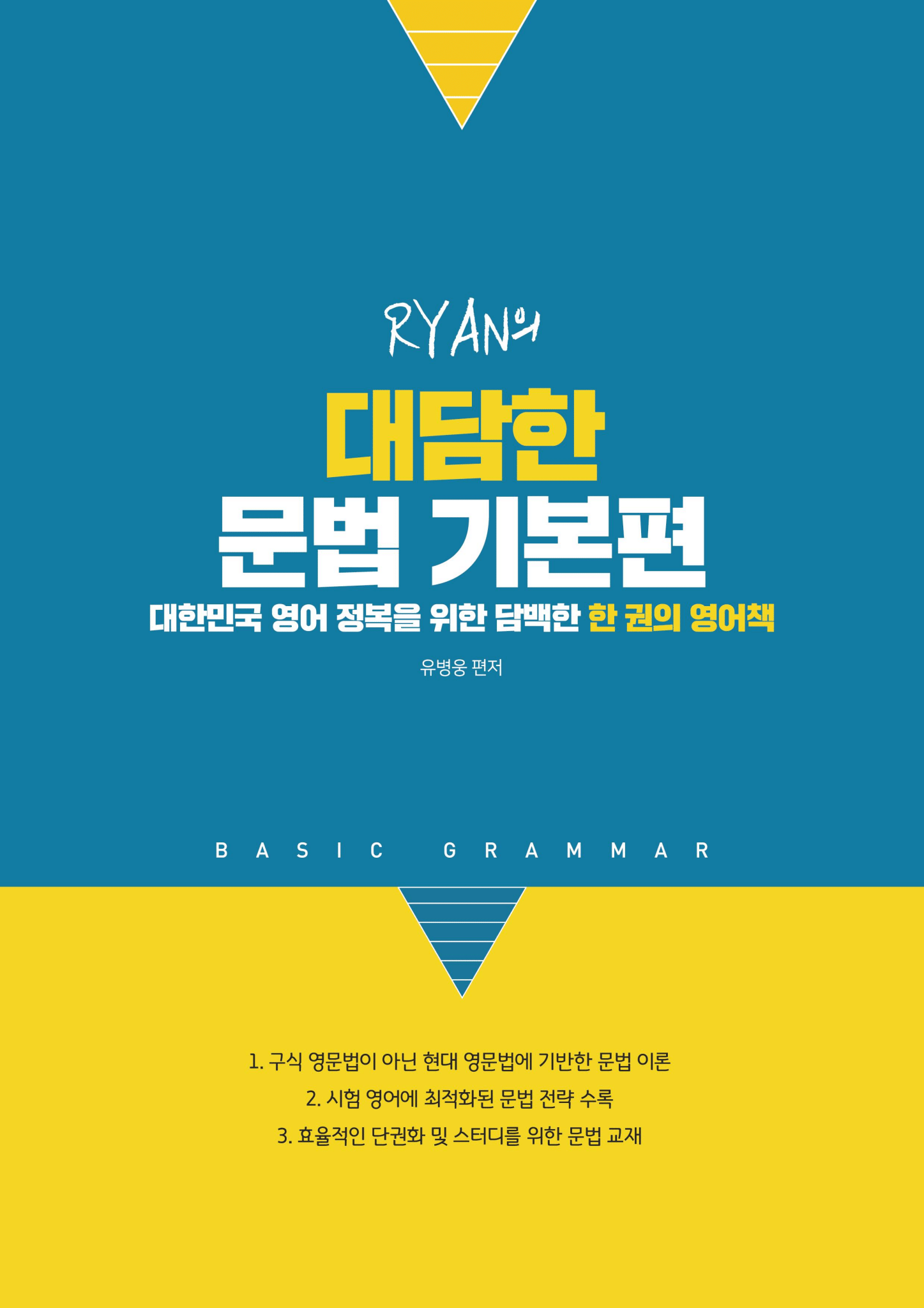
I enjoyed English long before I could explain its grammar clearly to someone else. Some sentences would not fit neatly into the five-pattern model I had learned. Familiar grammatical terms also became harder to use once I had to explain what they meant. I kept working through those questions as a teacher and brought them together in the February 2019 edition of RYAN’s Basic Grammar, then revised the explanations and examples for later classes.
I wanted to move away from the Japanese-derived terminology and memorisation-heavy explanations I had grown used to. That did not mean dispensing with terms or expecting understanding to replace all memorisation. I wanted the name of a grammatical feature to lead into an explanation of how a sentence worked. The grammar book, syntax workbook and handout on conditionals grew out of that concern. Eventually I also wrote down how I produced teaching materials, including practice tests.
Revising the grammar book beyond transfer-exam English
The first edition was written for students preparing for university transfer examinations. I organised it into four parts and sixteen units, beginning with sentence structure, then moving through tense and verb forms to clauses and other parts of speech. The aim was to keep using the earlier account of sentence structure as the explanations became more detailed.
In the 2021 revision, I broadened the intended audience beyond transfer-exam preparation, changing both the subtitle and the preface. I also added Korean translations to the opening unit’s examples of transitive and intransitive verbs. Reading the equivalents of “The door opened” and “I opened the door” together gives learners a situation to consider while they look for an object. The same verb appears in two different sentence structures. I wanted the example’s meaning to be available alongside the grammatical label.


The revised contents move from sentence structure through tense and voice to infinitives, gerunds and participles. Conditionals and modals follow, then noun and adverb clauses, and then adjective clauses. A clause contains a subject and a verb; within a larger sentence, it can do the work of a noun or a modifier. Later units cover agreement, determiners and pronouns, nouns, adjectives and adverbs, before ending with comparison and inversion. As the terminology accumulated, I tried to keep linking it to the elements of a sentence introduced earlier.
I offered the book as a PDF ebook. On 6 September 2026, the Kmong product page described it as 207 pages including the cover, with four parts and sixteen units. The product had one public purchaser review and a 5.0 rating. One review does not establish total sales or learning outcomes. The seller account’s overall transaction count is not a sales count for this book, so I do not give a unit-sales or revenue figure here.
The 2026 revision: applying familiar rules to unfamiliar sentences
A learner can know a grammar rule and still struggle to decide where it applies in a new sentence. That gap became the focus of my 2026 revision. I expanded the explanations to begin with what a sentence means and how its parts relate, then connect those relationships to grammatical forms, terminology and decisions in practice questions.
For infinitives and gerunds, for example, I compare the roles and meanings of the forms rather than only listing which verbs precede them. I also distinguish what a meaning-based explanation can account for from uses that need to be learned for individual verbs. The answer explanations give the reason for a choice, why alternatives fail and the contextual conditions under which another answer is possible.
The current student manuscript contains 24 units, 470 pages and 202 questions with answers and explanations. It moves from the core structure of a sentence through nouns, tense, modification and clauses to an integrated reading of longer sentences. It is intended for learners who need grammar for English examinations in Korea, including university entrance, civil-service and transfer exams, alongside their exam-specific practice books.
I clarified the targets of comparisons and the source labels, explained the table legends, and adjusted the page layout, including a heading that had been clipped. Whether readers can use these explanations to make decisions in unfamiliar sentences still needs to be checked with actual readers.
I also prepared a two-page publishing proposal and a 40-page sample containing the contents, the complete UNIT 15 on infinitives, gerunds and bare verb forms, and an excerpt from UNIT 24 on longer sentences. As of 13 October 2026, this is a proposal package in preparation, not a confirmed publication or publishing contract. The commercial-use conditions and rights for the exam and passage sources still need to be resolved before publication.
Giving the course book and workbook different jobs
An explanation needed a companion activity: something learners could do with an actual sentence. For the 2019 syntax course, I made a course book and workbook as a pair. The course focused on recognising how words belong together—finding the subject and the boundaries of a phrase, rather than reading only one word at a time.
The course book spans eight sessions. It starts with subjects and sentence structure, then introduces non-finite verb forms, which allow verbs to serve other roles within a sentence. Tense and passive constructions lead into modals and conditionals. Noun, adjective and adverb clauses each have a section, followed by comparison and inversion. From the first unit, I included practice in reading the whole subject phrase and the verb phrase as units.
The workbook follows the same eight sections, but makes room for choosing and writing answers. Its opening unit uses four types of activity: usage choice, translation, error detection and gap-filling. Selecting a form, explaining the meaning of a sentence and finding something wrong in it ask learners to do different things. I designed the exercises to approach the same structure in several ways.
Looking beyond a past-tense form in the conditional handout
Conditionals were a particular concern because a label or formula could take the place of reading the sentence. Treating every past-tense form as “the opposite of a present fact” could obscure its context. For a 2019 Kimyoung special lecture, I prepared A Complete Understanding of the Subjunctive around the relationship between verb form and the time or situation being described.
I compared conditionals using three categories. Type 1 covered general situations or conditions whose possibility remained open. Type 2 covered situations different from the present or presented as less likely, and Type 3 covered alternatives to the past. My purpose was to have learners read the condition and the following clause together: what was being said, and about when? I then connected that discussion to wishes with I wish and comparisons using as if.

For a 2022 Pcube class, I kept the title and main explanatory structure while changing some examples and a table. One replacement example considers whether a witness’s testimony is true now and describes a defendant’s earlier action. The Type 1 table also explicitly includes the simple past in the result clause. These changes kept attention on how the two clauses fit together, instead of treating the appearance of a past-tense form as sufficient to decide that a statement was counterfactual.
This was the teaching framework I used at the time, not a claim that it exhausts English grammar or makes every other account wrong. In both the 2019 and 2022 versions, I followed the explanations with application exercises.
Writing down the work of making a practice test
At EG English in 2021, I prepared a practice test to be taken under the same time limit as a school examination after the relevant course content had been covered. I wanted the format of reading the paper and writing answers to resemble the examination as well as the questions did. I recorded the production process so it could be followed again.
I began by recreating the layout of a previous examination PDF in Hangul, the Korean word processor. Direct conversion broke parts of the page, so I used a screen ruler at 100% magnification to measure spacing and reconstruct the tables and layout. Acrobat Reader provided the font information. Recording how I measured the page gave the next test a common basis, beyond simply trying to make it look similar.
For listening sections, I worked within the limits of the available recordings, cutting segments or changing questions where new material could not be inserted. I selected passages against the scripts and edited them with audio or video software. Instructions and question audio could be produced with text-to-speech, or TTS. The source recording still determined what could be changed.
For reading and written-response questions, I prepared a placement plan first. I examined eight previous examination papers from the preceding two years for their question order and proportions, placed passages suitable for written responses, and then arranged the multiple-choice questions. Eight is the number of papers compared, not a student count or a measure of prediction success. I matched fractional point values to difficulty, reconstructed the written-answer sheet by asking students what they remembered of its layout, and printed the test on B4 newsprint-style paper.
I noted in the briefing that production took substantial time and was relatively quicker the second time. This was not a timed before-and-after comparison. What I had put in one document were the conditions needed to make the test again, from page measurements through audio editing to print output.
The choices I made in each set of materials
The ebook listing and one purchaser review show that the material reached beyond my own classes. Exact sales, revenue and changes in student performance remain unverified.
Revising the grammar book meant returning to both terminology and examples. The syntax pair separated explanation from practice, while the conditional handout went into another classroom after further editing. For test production, I went as far as recording the measuring method and print conditions.
Public notices from that period include Kimyoung’s 2019 holiday programme announcement and a Leadwin instructor listing. The lecture-title and instructor-name references rely on checks made on 4 September 2026; they do not establish a current teaching schedule or employment status.