
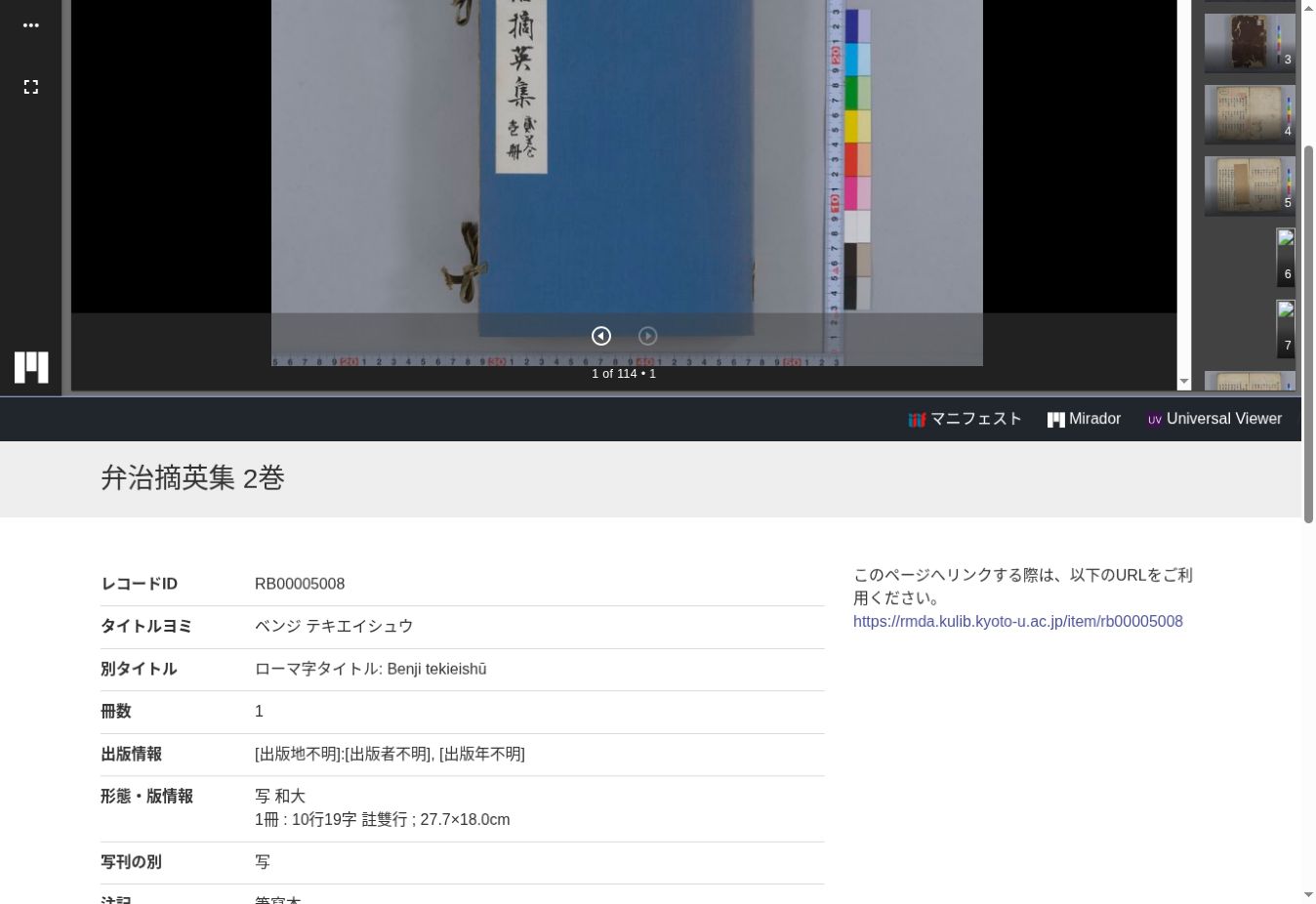
I came across Benji Tekieishū (辨治摘英集) while looking for overlooked medical writings from Joseon Korea. Kyoto University’s public catalogue attributed the book to “(朝鮮)恵庵 撰”: compiled by Hyeam of Korea. Yet the note at the end gives the name 惠庵 and a date corresponding to 1609 without calling that person Korean. I compared older catalogues with the public records and asked the holding library what supported the attribution.
On July 31, 2026, Kyoto University replied that it had found no supporting author information in the ledgers and old catalogue card it examined, and had removed the author row from KULINE. Later checks also showed changed fields in other public records. The work did not identify Hyeam; it helped correct a catalogue attribution whose basis could not be established.


What the book says, and what the catalogue added
A closing note can record when or how a text was prepared. This one reads “時慶長拾四(己酉)歳初冬上澣日撰之/惠庵,” including the fourteenth year of Keichō, or 1609. That is a date in the note. It does not, by itself, establish when the surviving copy was made or when the original work was first composed.
The current catalogue also retains “日本人筆写,” a note stating that the copy was made by a Japanese person. The surviving copy’s binding and Japanese reading marks offer evidence about copying and use, but they do not settle the original writer’s identity or nationality. I kept those questions separate rather than replacing a Korean author attribution with a Japanese one.
An author field does more than transcribe a name from a page. It registers a person as the author so that the record can be searched and linked to other works. Finding 惠庵 in a closing note therefore did not answer the question I needed to check: what justified registering that person as Hyeam of Korea?
Two books under one name, with a difficult chronology
In the 1904 Zōtei Kokusho Kaidai (增訂國書解題), page 1780 lists “辨治摘英集 二巻 惠庵 友把,” without a Korean designation in that entry. The earliest occurrence of the designation I found among the catalogues examined was in Kyoto Imperial University’s 1942 medical catalogue. That does not establish 1942 as the year the error originated.
I compared the individual entries with the author index. In the combined volume, page 327 lists Benji Tekieishū and page 332 lists Bangyak Happyeon (方藥合編). The index on page 463 points to both under a single “惠庵〔朝鮮〕” heading. Benji entry · Bangyak Happyeon entry · Author index
Hwang Do-yeon, the author of Bangyak Happyeon, used Hyeam as a sobriquet and was born in 1808—almost two centuries after the 1609 date in the other book’s closing note. Treating the two names as one person would require an explanation of that gap. A shared name offered a possible explanation for the grouping, but the index alone could not prove how the attribution had arisen.
The work entries also carry different notations: “和大” and “朝鮮大,” respectively. Interpreting these as descriptions of binding or national origin would require the catalogue’s key to those abbreviations. What I could establish was narrower: the entries differed, while the author index brought their page references together. The index grouping was clear; the abbreviations still needed a key before I could interpret them.
Asking the library what supported its entry
To make the enquiry traceable to the right object, I matched the record ID RB00005008 with its shelf mark and registration number. In my July 21, 2026 enquiry, I pointed to the former author attribution and the “日本人筆写” note, asking whether the library’s ledgers, cataloguing records or other checks could establish the basis for the author and nationality information.
The July 31 reply described a check of the book ledger, acquisition-related records and old catalogue card. The library could not confirm the author information from those materials. It said the short description in the 1942 catalogue appeared to have entered the author field when the initial data were created, and reported that it had removed the KULINE author row.
The removal was a confirmed action. The account of how the 1942 wording entered the database was the library’s suggested explanation, not a demonstrated chain of events. Nor did the reply establish that no supporting evidence could exist anywhere: it described the records the library had checked.
Checking each system on its own dates
The same book appeared in KULINE, Kyoto’s online catalogue; RMDA, its digital archive; and an author authority record at Japan’s National Institute of Japanese Literature, or NIJL. An authority record connects an author name to works. I kept dated observations for each system, since a public page does not reveal when or how another service updates its data.
| Record | Earlier state | Later observation |
|---|---|---|
| Kyoto KULINE | Author row “(朝鮮)恵庵 撰” | Library reported removing the row on July 31, 2026 |
| Kyoto RMDA | Former author row in the May 15, 2026 archive capture | No author row in the September 3, 2026 check |
| NIJL authority 660118 | country was 朝鮮 in the API response preserved on July 31, 2026 | Empty string in the September 3, 2026 response |
The official responses checked again on September 6, 2026 showed the same later state. KULINE and RMDA have no separate author row, while 惠庵 remains in their transcription of the closing note. NIJL’s country field is blank, but the 恵庵 authority and its link to Benji Tekieishū remain. The work entry still includes wauthor: 恵庵 and wyear: 慶長一四. KULINE · RMDA · NIJL authority response
KULINE’s deletion is the action the institution directly reported after my enquiry. I could observe the changed RMDA and NIJL fields, but not identify each editor or establish an automatic transfer from KULINE to the other services. Those observations do not prove a single propagation route.
The identities of 惠庵 and 友把, Hyeam’s nationality, and the original work’s place of composition remain unresolved. I ended this correction at that boundary: retaining what the book actually says without filling an uncertain author field with another nationality.